
Chuck Klosterman's Football
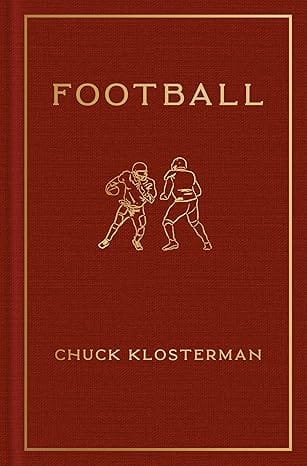
Despite his arm talent, Ferragamo struggled in Canada because he couldn’t adjust to a configuration of a sport that’s more dissimilar than it appears on TV. The downs were too different. Canucks stuck with the number 3 and we picked the number 4, and that altered everything about both versions. It’s not a subjective divergence. It’s not a relativist dispute. And this should make you feel good, even if you live in suburban Regina.
— Football
It feels strange to start writing about a book primarily about American football by leading with a quote from the chapter about the CFL (Canadian Football League). And yet, it feels appropriate. I think Klosterman would appreciate me starting that way since it combines a few of my favourite things: Canada, football, and the city of my alma mater, the University of Regina. I have been following and reading Klosterman for many years (see The Nineties, his last book I wrote about here). When I heard his appearance on the Bill Simmons podcast earlier this year talking about this book, I knew it was going to be an instant purchase.
It felt strange buying and reading a book that wasn’t written for me. Klosterman repeatedly mentions this on the podcast interviews he’s done about the book. This book is for people 100 or 150 years from now when football as we know it doesn’t exist anymore. Not quite an obituary for something that is still very, very alive in America, but more of an overview of why we care so much about football and how it became to be so important in our culture.
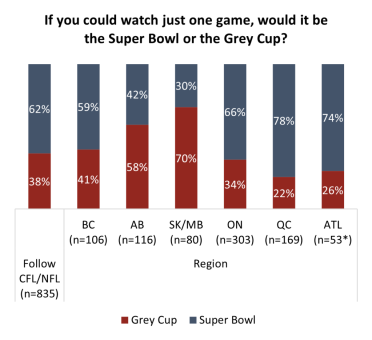
The whole book is simply great. I quite enjoyed reading about Klosterman’s history with football, both watching and playing when younger, and explaining some of the other phenomena surrounding the game like why the Dallas Cowboys are America’s team. My favourite essay is about the CFL: how quirky it is, comparing 4 down football to 3 down football, and why more Canadians watch the Super Bowl than the Grey Cup each year.1
I’m not at all surprised that people on the prairies would choose the Grey Cup. If you’ve ever been to a football game in Regina or Winnipeg, the fans live and breathe the CFL for six months of the year (the other six months are reserved for hockey or curling, of course). When the Saskatchewan Roughriders won the Grey Cup last season, the city of Regina (maybe all of Saskatchewan) shuts down to celebrate. It’s quite a sight after the victory and the parade coming down Albert St towards the Legislature in front of the fans. I mean, look at this:
Klosterman doesn’t get into the future of the CFL apart to say it will need 3 down football in order to stay relevant. I tend to agree with that. I also have a feeling that the CFL is going to become more regionalized and smaller, similar to junior hockey throughout Canada. This summer, the BC Lions are playing two games in my city of Kelowna because of the World Cup happening in Vancouver. It’s a huge deal for the city and the Okanagan. Both games are nearly sold out as well with an expanded seating capacity of around 20,000. I could see a team being in Kelowna in the future and acting like a professional team in Las Vegas (pulling in the visiting team fans more than building a local fan base). A team in Moncton or Halifax would draw well like past games there, and Victoria is nearly sold-out for a pre-season game. Maybe Saskatoon to divide Saskatchewan fans, or Red Deer to add to Alberta.
It’s hard to imagine a day when football doesn’t matter to anyone in North America, but perhaps the regionalization of the sport is exactly the kind of slow decline Klosterman is writing about. Remember, he isn’t writing about football dying in 20 years. He is writing about it disappearing in the next 100-150 years. Besides the economic factors that will make the sport smaller2, Klosterman writes about a real threat to the sport that had a lot of people talking twenty years ago, and not so much anymore: C.T.E. (Chronic Traumatic Encephalopathy, the brain disease caused by repeated head impacts). It’s a serious problem in football and contact sports in general.
In a chapter devoted to the topic, Klosterman writes:
Football is fucking dangerous. Its physicality is uncompromising, and no one knows if the reward trumps the risk. It’s crazy that we do it at all. It’s crazy that it controls the culture. It’s crazy that it defines huge swaths of the country, including some swaths that barely care.
The same could be said of hockey in Canada, another sport that it’s impossible to imagine dying off in Canada the way it is ingrained in our culture. We all accept the violent nature of those sports by encouraging them to make bigger hits or drop the gloves3, but at some point, we will cross a line where the violence is too much. Or rather, the risks involved are too much for the players to accept and the owners to be responsible for.
Klosterman uses his book to describe the effects of football on American culture, but an unanswered question for me is what happens to American culture with the absence of football and the Super Bowl, or what happens to Canadian culture without the Grey Cup or Stanley Cup? Thankfully, that isn’t a problem I will have to deal with in my lifetime, nor will Klosterman. In the meantime, we can both enjoy the strategy, the violence, the drama, and the culture surrounding football by watching the players wearing Roughrider green or the crazy fans wearing the watermelon helmets. And, hopefully, I will be able to watch more CFL football in the Okanagan sunshine in the coming years.
Football is a good, fun read from a well-versed and fun author in Klosterman. It’s a quick read covering the history of the game, the media, and some of the larger concerns surrounding the game. But it also includes fun cultural references like the Roughriders and Rough Riders, or Mitch Hedberg talking about corn and corn cobs in relation to why football is called football in the first place. Highly recommended.
"A hilarious but nonetheless groundbreaking contribution to the argument about which force shapes American life the most. For two kinds of readers—those who know it’s football and those who are about to find out."
- I was quite surprised by that stat, but it appears to be true after looking it up. I also found this interesting poll from Angus-Reid showing which game most people would watch if they could only choose one.
2. Besides owners pricing out everyday fans to maintain their profit margins, the NFL's entire financial foundation is shifting. I highly recommend reading this post at Undrafted, which looks at Klosterman's book through a materialist lens. John argues that as traditional TV dies and gambling revenue takes over, the NFL will stop trying to appeal to the masses and just focus on extracting cash from hardcore bettors. That kind of economic shift might kill football's cultural dominance long before C.T.E. does.
3. Although fighting in hockey has dropped off quite a bit since I was a teenager, a brawl still gets the whole crowd on its feet and proves that Canadian culture leans heavily on the physical nature of the sport. This is especially since the 'elbows up' campaign became our natural response to Trump last year.
Member discussion